Why Production Alerts Arrived 2 Hours Late: 8,886 Timeouts in a FIFO Queue
#Alerting#FIFO Queue#Timeouts#Log Forensics
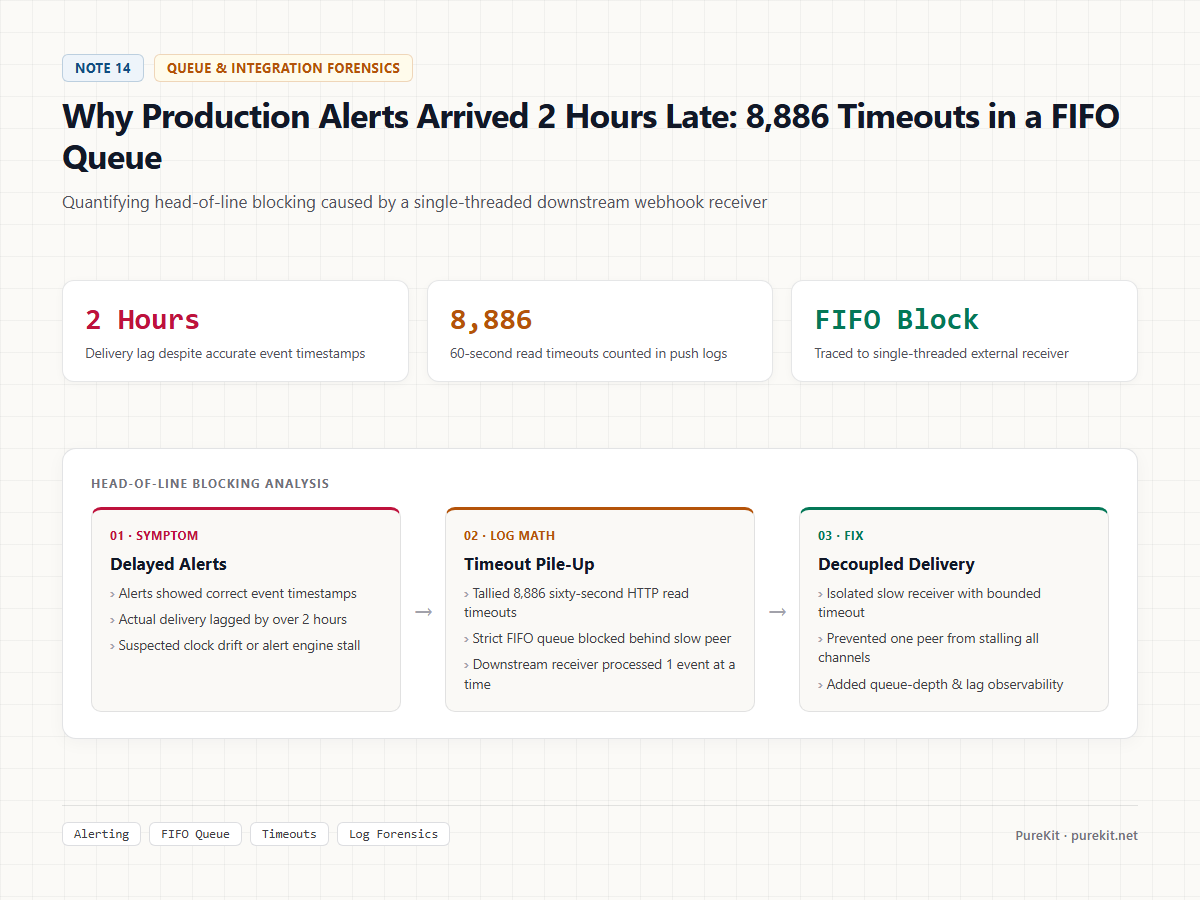
The Symptom
Operations noticed that critical alerts were arriving 2 hours late, even though the event timestamps inside the alert payloads were completely accurate—ruling out NTP clock drift.
Log Math Never Lies
Parsing the alert-push logs exposed 8,886 separate 60-second HTTP read timeouts. Tracing the delivery architecture showed a classic head-of-line blocking failure:
- Alerts were pushed through a strict FIFO queue.
- A downstream integration receiver processed incoming webhooks single-threaded, frequently hanging past the 60-second read timeout.
- Because every slow or hung delivery blocked the head of the FIFO queue, thousands of subsequent alerts piled up behind it until delivery lag crossed 2 hours.
Remediation
- Enforced tighter per-request timeouts and isolated slow third-party receivers from core alert channels so one sluggish integration can never stall the whole pipeline.
- Added queue-depth and delivery-lag metrics so backlog growth triggers an early warning within minutes.
Enjoyed this note or seen a similar bug?
Feel free to drop a line—always glad to exchange ideas with fellow engineers.