Building a Production Prometheus Monitoring Framework for Database & Linux Clusters
#Prometheus#PostgreSQL#Observability#TLS/mTLS
The Challenge
Multi-node Linux clusters running PostgreSQL, InfluxDB, and distributed caching layers often suffer from two opposite observability failures: either teams fly blind until disks or locks blow up, or ad-hoc exporters explode Prometheus memory with unbounded labels and fragile startup scripts.
Architecture & Engineering Decisions
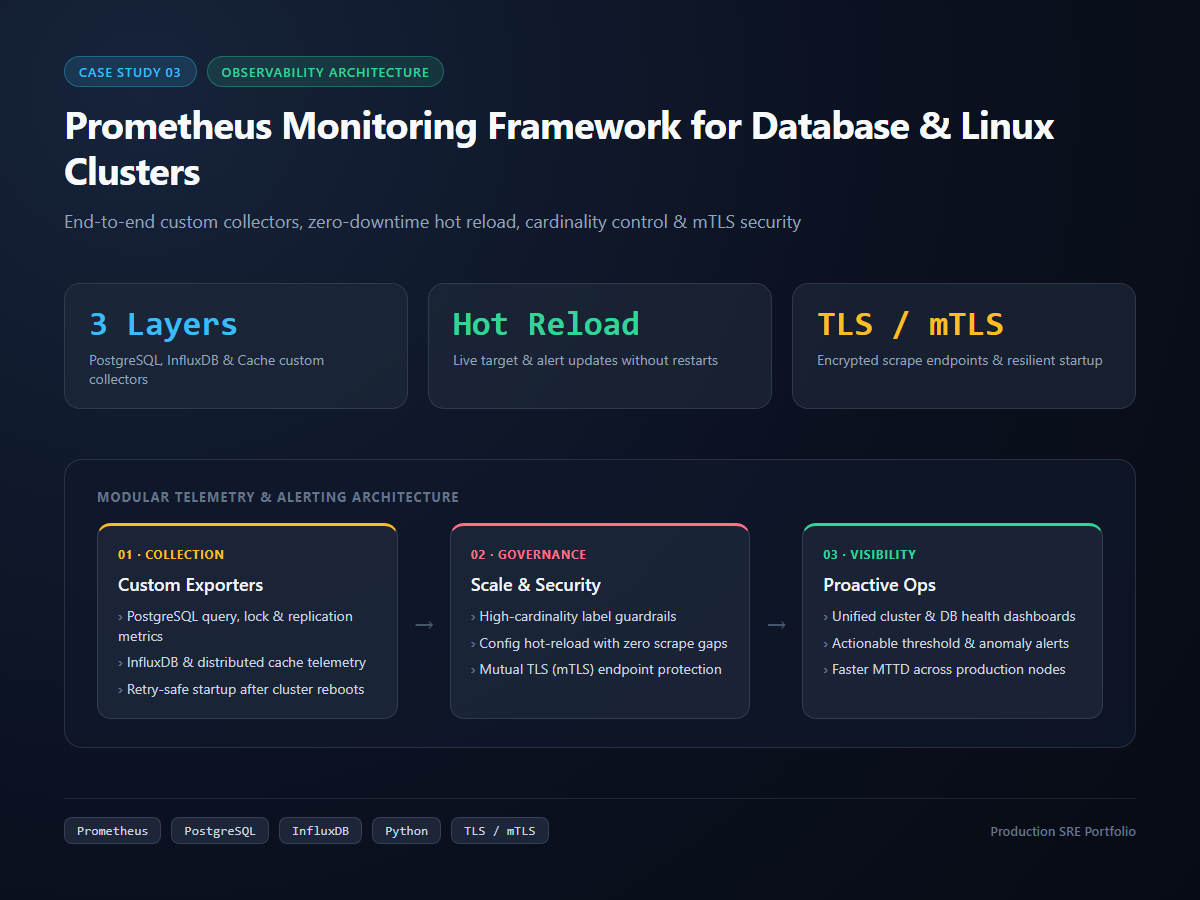
I designed and built a unified Prometheus monitoring framework from scratch around four production constraints:
1. Purpose-Built Custom Collectors
- Exposed actionable PostgreSQL metrics (connections, locks, replication lag, bloat/disk signals) alongside InfluxDB and cache-tier telemetry.
- Hardened collector initialization with clean retry backoff so a node reboot race never leaves monitoring threads silently dead while the process still reports
running.
2. Zero-Downtime Configuration Hot-Reload
- Operations teams frequently add scrape targets or adjust alert thresholds.
- Built config hot-reload support so targets and rules apply atomically without restarting collectors or creating blind gaps in time-series data.
3. High-Cardinality Guardrails
- Enforced strict label allow-lists and bounded metric dimensions so transient IDs or error strings cannot trigger time-series cardinality explosions.
4. Encrypted Telemetry with TLS / mTLS
- Secured metric scrape endpoints with TLS and mutual TLS (mTLS) so internal cluster metrics are authenticated and encrypted in transit.
Outcome
The framework delivered predictable resource usage, zero-gap config updates, and proactive alerting across production database and Linux clusters—cutting mean time to detect critical anomalies before they turned into customer-visible outages.
Enjoyed this note or seen a similar bug?
Feel free to drop a line—always glad to exchange ideas with fellow engineers.